


 newsitems CLRAE President Frecon to EuroFora on Ukraine's Regional DeCentralisation and UK Devolution process
CLRAE President Frecon to EuroFora on Ukraine's Regional DeCentralisation and UK Devolution process


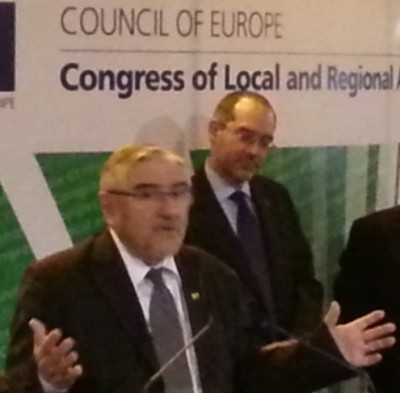
*Strasbourg/CoE/Angelo Marcopolo/- Replying to an "EuroFora" Question on the possible use of UK's Devolution process as one among several eventual Examples for a Solution to the Crucial for Peace problem of Regional DeCentralisation in Ukraine Today, the experienced President of PanEuroepan CoE's watchdog on Local and Regional Democracy and Self-Government, the Congress of Local and Regional Authorities of Europe (CLAE), Jean-Claude Frecon, from the Governing Socialist Party in France, did not exclude at all that the UK "might Inspire" Ukraine, while also carefuly noting, however, the fact that "the situations are Different", so that concrete Solutions could not be purely and simply Copied and pasted, from one Country to another, but needed to be thoroughly and seriously examined in order to find the most Adequate formulas.
CLRAE's President was topicaly speaking at a Crucial moment for the Fate of the latest Minsk Agreements on a sustainable Cease-Fire and Peace in Ukraine, where, after the recent withdrawal of Heavy Weapons, it's mainly the issue of Dialogue between all sides on Key Reforms for a DeCentralisation of Power, which remains to be done, added to Local Elections and concluding by a concerted re-establishment of Kiev's control of the Ukranian Borders at Neighbouring Russia.
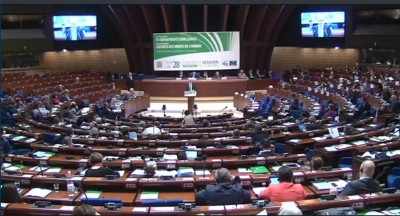
That's why Frecon spoke with "EuroFora" on that matter right at "the Beginning of CLRAE's Spring 2015 Session this week in Strasbourg, just after a landmark Debate on UK's "prospects for Devolution", with Senior Government, Parliamentary and Regional Brittish Officials, including from Scotland, (on the Future of which, CoE has scheduled another Debate for Tomorrow Noon, Wednesday, March 25), but also at the Eve of an Important CLRAE Debate and Vote of a Resolution on the "Regional Dimension of DeCentralisation in Ukraine", Tomorrow early Morning, for which various "Hot" Amendments were expected.
As a matter of general Principle, the still unfolding UK's Devolution process is certainly something Welcome, from the point of view of COE's Local and Regional Democracy Principles, provoding for the Wider possible Local:Regional Autonomy; while fully Respecting the Territorial Integrity of the whole Country inside which such developments take place, and should normaly Inspire also several other European Countries, including, I Hope, even mine, added earlier the Senior French politician, (by a coincidence speaking also at an Anniversary year for the World-famous Brittish "Magna Carta" Historic precursor Legal document on Human Rights, notoriously adopted 8 Centuries ago, on June 1215)...
-------------
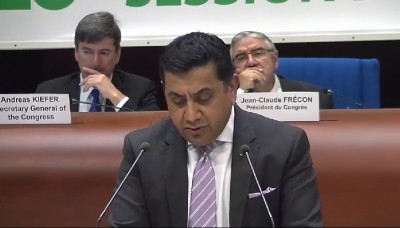
⦁ Meanwhile, Liord Ahmad of Wimpledon, under-Secretary of State for Communities and Local Government, spoke this Afternoon at the CLRAE Plenary Debate about the Brittish Government's current Plans to enhance DeCentralisation also inside England itself, particularly around Big Citires such as Manchester, etc., focusing mainly on the Financial aspects.
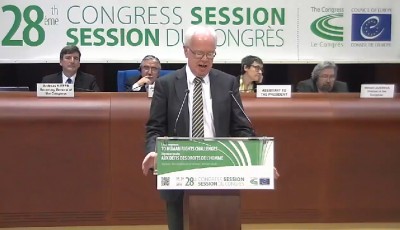
⦁ In addition, Lord Wallace of Tankerness, PV QC, Advocate General for Scotland, described particulalry the further Devolution process for the Scottish Region, which had been promissed by the Brittish Government just after the recent Referendum.
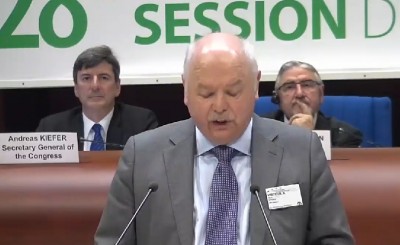
⦁ Moreover, other Topical prospects for Devolution to Wales, Northern Ireland and England were presented by the Chairman of the Local Government Association in these areas, and elected Councilor, David Sparks, before a Wider CLRAE Plenary Debate on all relevant Developments inside the UK.
⦁ All three also insisted on a "Transparent and Accountable" Local/Regional Democracy to be guaranteed in the concerned areas.
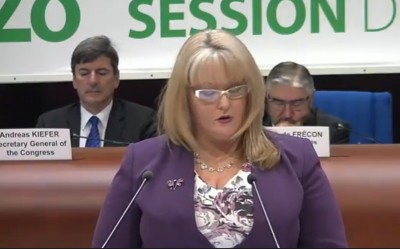
⦁ Last, but not least, Scottish Parliament's European and External Relations Committee's Convenor, Christina McKelvie, from Scotland's National Party, who had fought for the acceptance of the recent popular Referendum of Independence, made a Critical appraisal of the relevant History, focusing mainly on the Promisses for a more substantial Devolution, made by London's Government "at a last minute attempt" to dissuade People to vote for Independence, (which lacked only 5% of Votes in order to be adopted by a Majority of more than 50%) : - I feel that we are now at "a Grey" period, when the Future isn't yet clear enough, she denounced, Warning London that, if things don't evolve in a satisfactory way, then, Scottish People will anew relaunch the struggle for Independence, again and again, until we get full Subsidiarity working, with the Local/Regional level having, in Principle, got practically all needed Competences in order to manage its own affairs, except from the Defense and Foreign Policy instruments, as she ambitiously said in conclusion.
⦁ This last point, Topicaly reminds French Senate's President, Larcher's recent suggestion for a Solution at the Eastern Ukraine conflict, who had proposed, (on the occasion of an official Visit to Germany's Bundesrat and Bundestag's Leaders, following a previous one in Russia's Council of Federation and Duma, before completing also with Kiev's Rada soon), to be inspired from a similar example as that of the French OverSeas territories, known as "DOM-TOM", where "the Regalian competences remain at the hands of the Central Government, while, on the contrary, People's everyday life issues (including Economy, Social, Culture, Education , Science and Technology, Health, Environment, etc), would be Transfered to Local:Regional bodies., as he said, (See relevant "EuroFora"s Newsreport : http://www.eurofora.net/brief/brief/senatepresidentlarchermovesforukrainepeace.html ).
⦁ + COE's Secretary General, Thornbjorn Jagland, during his recent Visit to Kiev, where he met both with Foreign Minister Klimlin and the Ukranian President Poroshenko, etc, reportedly suggested that Ukraine's DeCentralisation of Power inspires itself from various interesting Examples in Europe, as such of differend Regions, with various Degrees of Autonomy, f.ex. in Switzerland, Italy, Belgium, the UK, Spain, and even at his own Country : Norway, etc.
⦁ Norway, indeed, is included among 3 COE Member Countries, together with Poland and Greece, whose Local and Regional Democracy will be checked this week in Strasbourg by three relevant Debates and Votes during this CLRAE Session. On Poland, CLRAE's Draft Report mainly asks for more Financial Autonomy at the Local level, while, in Norway, it's much more the Freedom of Regions to Decide how they want to manage their own affairs, which needs to be Guaranteed, according to CoE's relevant texts.
⦁ Concerning specifically Ukraine, Tomorrow Morning's Debate is scheduled to take place with the Participation of vice-Minister for Regional development, Vyacheslav Nehoda, (as also the Following Debates on Poland and Norway, next Thursday, march 26, are due to include the competent State Secretaries Stanislav Huskowski and Jardar Jensen, respectively, while Greece's new Minister of Interior, Nikolas Voutsis, already anounced here Today "a new Institutional and Economic Framework for Local Government"), as well as Local Representatives from Kharkiv, Odessa, etc, but not yet from the Donetsk/Luhansk Autonomist Regions, despite Minsk Agreements' call for an inclusive Dialogue, particularly on DeCentralisation Reforms and Local Elections, etc, as well as concertation and/or agreements through the Minsk Group of Contact, etc.
⦁ CLRAE had already Criticized the previous situation of Local/Regional Democracy in Ukraine at the Past, as it results, f.ex., by an official Recomendation adopted on 2013, (i.e. BEFORE the recent Clashes of 2014-2015), which had Denounced f.ex. the fact that, regretably, "Legislation limits the Local Authorities' Ability to take Decisions and Manage their own Affairs", and that "several Towns and Cities ... remained without an Elected Mayor, for Long Periods, owing to a Gap in the Electoral Law, which Undermines ... Local Self-Government", as well as "the Limits put on Local Governments' Financial Autonomy", and the possible "Interferences from the Central level in the Person of the Head of Administration of Local Authorities, added to attempts to "ReCentralise Competences", (etc).
⦁ => That's why, a CLRAE's Recommendation to COE's Committee of Ministers, had asked, since 2013, f.ex. to "Grant Local Authorities Competence for a Substantial Share of Public Affairs", "organise Elections for Mayors in Cities where this post has been Vacant for a Long Time", to "ReinForce the Financial Autonomy of Local Authorities", and "Transfer to Elected Representives" the "Competences of Districts' and Regions' Administrations', in order "to Establish an Administration under their Responsibility", as well as to "ReVitalise peri-Urban and Rural Areas" against "Demographic, Economic and Social Decline", and "involve Local Authorities" in such Strategies, (etc), "if necessary, by a Revision of the Constitution".
(../..)
***
("DraftNews", as already send to "EuroFora"s Susbrcibers/Donors, earlier. A more accurate, full Final Version might be published asap).
***
Main Menu
Home Press Deontology/Ethics 2009 Innovation Year EU endorses EuroFora's idea Multi-Lingual FORUM Subscribers/Donors FAQs Advanced search EuroFora supports Seabird newsitems In Brief European Headquarters' MAPs CoE Journalists Protection Platform
BRIEF NEWS
- 00:00 - 02.06.2021
- 00:00 - 18.10.2020
- 00:00 - 19.06.2020
- 00:00 - 18.05.2020
- 00:00 - 20.04.2020
- 00:00 - 02.02.2020
- 00:00 - 09.12.2019
- 00:00 - 27.11.2019
- 00:00 - 16.11.2019
Popular
- Yes, we could have prevented Ferguson riots says World Democracy Forum's Young American NGO to ERFRA
- Spanish People Elect CenterRIGHT Majority with 1st Party and Total of 178 MPs (6 More than the Left)
- Pflimlin's vision
- The European Athletic "Dream Team", after Barcelona 2010 Sport Championship Results
- Source Conseil d'Europe à ERFRA: Debatre Liberté d'Opposants à Loi livrant Mariage+Enfants à Homos ?
- Head of BioEthics InterGroup, MEP Peter Liese : "Embryonic stem cell research reaching its END" !?
- Spain: Jailed Turkish Terror suspect with Explosive,Drones,Chechen accomplices stirs Merah+ Burgas ?
- UN Head Ban Ki Moon at CoE World Democracy Forum : - "Listen to the People !"
Latest News
- Test Photos (f.ex.+ Invit to EU + Korea Peace meeting)
- EUOmbudsmen Conference 2022: Digital Gaps affect People's Trust threaten EF Project on EU Future ?
- French Election : Black Out on Virus, but Obligation for Fake 'Vaccines" Challenged
- Both French Presidential Candidates point at "Humanism" in crucial times...
- France : Zemmour = Outsider may become Game Changer in Presidential + Parliamentary Elections 2022
Statistics
Visitors: 62401076Archive
Login Form
Syndicate


Other Menu
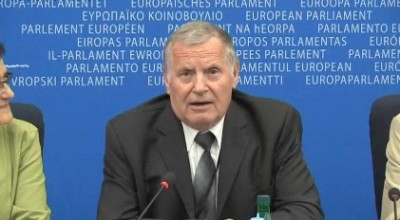
Former "Green-Red" German government's Foreign Minister Joschka Fischer's job at the controversial Turkish pipeline "Nabucco" was denounced as "not proper", "very bad", and "incompatible with Democracy", by the new President of EU Parliament's EuroLeft Group, German Lothar Bisky, replying to an "EuroFora" question.
For once, criticism of Joschka Fischer's doings with Turkey affecting Europe, didn't come only from the Center-Right of the political spectrum, but even from his Left side : The experienced Bisky, who has been chairing all over 1993-2009 the PDS - Die Linke party :
- "Former Foreign Minister Joschka Fischer got involved in dealings with oil-gaz business in a foreign country, Turkey, and its controversial Nabucco pipeline. This raises questions about Democracy, also because of the well known problems of Human Rights violations in that country. Do you thing that this might be abused in order to cover up and close EU's eyes on Human Rights violations ?", "EuroFora" asked Bisky.
- "Nabucco pipeline is (only) at the planning stage". And "there are some difficulties", he observed from the start. But "'I don't want to get into the details of Nabucco pipeline, because I don't think that there is any point for it at the moment".
At any case, "we (EU Parliament's EuroLeft Group) strongly believe that Politicians should not get involved in the Energy Business, and all these commercial transactions", President Bisky declared on the Joschka Fiischer's affair.
- "We feel that it's something that shouldn't be done. It's not proper !"
- "We don't think that it's compatible with Democracy either, and it gets politics into a very Bad track", Bisky went on to denounce.
- "EuroLeft and "Die Linke" always spoke against that, saying that politicians should not get directly into the arms of private enterprises"
- "It is pretty bad if a former Minister takes a job f.ex. in a major Energy producer. So, it's an issue if a Minister who may have seen excellent opportunities, subsequently gets personally grasp of them, in very serious parts of the economy, once he has given up his (Government) job."
- "It doesn't really make politics in general look any better'", Bisky concluded.
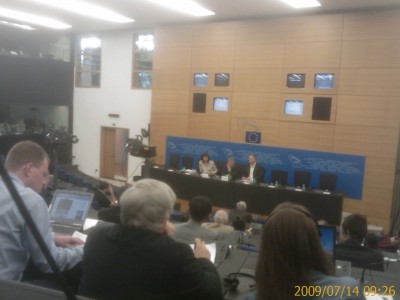
Earlier, this week in Strasbourg, other Journalists had also raised critical questions on former Foreign Minister Joschka Fischer's involvement in the conroversial Turkish Nabucco pipeline to the President of his own EuroParty : Kohn-Bendit of the "Greens", who, contrary to Bisky, tried to find excuses for Fischer, while criticizing his long-time partner, Schroeder for having done a similar move :
- "Shroeder was chancellor", and he "negociated" with "Russians", who gave him a job only "3 Months" after he resigned from the Government. While "Joschka Fischer", on the contrary, got a job with the controversial Turkish Nabucco pipeline only "4 Years after" he left the Government. "He didn't negociate Nabucco", so I have "no objection", Kohn Bendit claimed.
But, many Facts indicate the contrary :
Joschka Fischer was Foreign Minister in Germany from 1999 up to 2005 : I.e. from the year that EU took the controversial decision to give Turkey a "Candidate" status, until he year it started controversial "accession negotiations, (later declared "open-ended" after Sarkozy-Merkel's arrival from 2005-2007).
During that period was prepared the controversial so-called "Annan" Plan (in fact, drafted by others and attributed afterwards to the former UN SG) on Cyprus, which failed after a Popular Referendum said "No" on 2004 with a large Majoriy of 3/4 : 75%. Mainly because it was criticized for making too much concessions to the Turkish side : Particularly by restricting Greek Cypriot Refugees' Human Right to return to their ancestral Land and/or get restitution of their Familiy Homes and private properties, usurpated by Ankara's Army since the 1974 militay invasion and continuing occupation of the northern part of Cyprus. And by weakening the Central Government, leaving to 2 "constituent States" so much powers and separate interests that more conflicts appeared inevitable, provoking the danger of a break-down in the foreseable future, with more crisis, troubles, perhaps bloodshed, etc., instead of creating an harmoniously integrated, really one federal State.
The controversial Plan was finalized on March-April 2004 at Burgenstock (Switzerland), curiously in the presence of an Envoy by the Ministry of Foreign Affairs of Germany, then governed by Joschka Fischer, but in the absence of a French and not even an European Union's Envoy, contrary to what was usually practiced on similar occasions in Switzerland (fex. in 1997 at Montreux, in 2000 at Geneva, etc).
Turkey notoriously exploited the failure of the "Annan" Plan in order to convince the EU to decide to start accession Negotiations on December 2004. This provoked an unprecedented series of Institutional Crisis inside the EU, shortly afterwards, when French and Dutch People rejected, 2 popular EuroReferenda by a majority "'No" vote to the EU Constitutional Treaty on 2005, aggraveted in 2004 a Majority Abstention to EU Elections, etc., followed by the recent Irish "No", etc.
"Nabucco" Gas pipeline was notoriously planned since ..2002. It follows an even earlier idea, for an Oil pipeline Baku-Ceyhun, which started to be prepared on 1999-2001 and was meanwhile recently completed.
So, facts indicate that what is now at stake is based on decisions made during Joschka Fischer's term as former Foreign Minister, closely interested in Turkey's controversial EU-bid.
To the point that he now practically ...switched jobs with a poliician from Turkey, (the State which pays today openly Joschka Fischer), Mr. Ozdemir, who came earlier in Germany, got fast the nationality, and became EiuroMP in a few years, continuing now as head of the "Greens" in Germany, i.e. in Joschka's former job !...
Such astonishing facts risk, unfotunately, to give to German politician Lothar Bisky's criticism of representative Democracy a topical meaning :
- "We (EuroLeft Group) think that what is really at stake is Democracy. It's not only about Gas Pipelines or Energy sources", President Lothar Bisky went on to add in his reply to "EuroFora"'s question on Joscka Fischer's personal interests in the controversial Turkish "Nabuco" pipeline.
Such facts, "make People get more distance from Politics. ...People had had enough, and they are fed up !".
- "That's why we (EuroParliament's "EuroLeft" Group) want to strengthen Direct Democracy in Europe. Citizens should be involved in the (EU) Decision-making. In the end of the day, it's not going to help anyone if Politicians are always taking decisions, without involving Citizens. We want to give a voice to the People of Europe. They've got to have their say in the decisions that are taken. That's one of our absolutely fixed and steadfast views. We want more Direct Democracy in Europe. That's how it can become more effective and stronger", he concluded.
-