


 newsitems CoE Statistics: Turkey= Longest+Most Failures to apply ECHR Judgements +Worst+Growing New Violations
CoE Statistics: Turkey= Longest+Most Failures to apply ECHR Judgements +Worst+Growing New Violations



*Strasbourg/- According to the latest official Statistics on the implementation of ECHR's judgements, published today by CoE's Committee of Ministers, Turkey holds the PanEuropean Record for the Longest Failures to Comply with ECHR's judgements, with the most cases of Serious Human Rights' Violations, and, moreover, it's also the No 1 origin of the Highest and Growing Number of "New" Condemnations by EuroJudges even on 2012, despite an unprecedented effort by CoE's officials to rapidly Settle pending cases with various, even unorthodox ways, recently...
To put it in a nutshell, converging Facts reveal that Ankara not only remains still the most important "Classical" Problem of serious Human Rights' Violations among CoE's 48 Member States, but it's even becoming a Growing Concern for the Present and the foreseeable Future, as far as ECHR judgements' disrespect is concerned.
------------
* In particular, Turkey still has the Greatest (and Growing) Number of important "Leading" cases still "Pending" for execution under the supervision of CoE's Committee of Ministers : 178 such cases in 2012, followed by Russia, Bulgaria and Ukraine (with 157, 108 and 106 respectively), Romania, Poland and Moldova (88, 76, and 70, respectively), Italy, Greece, Croatia, France and Serbia (62, 59, 46, 42 and 34 each), Azerbaidjan, Hungary and Latvia, FYROM (25, 24 each, 21, respectively), etc., the Lowest number being that of Denmark, Lichtenstein and Monaco : "0" = Zero.
* But the Worst is that Turkey also has (by far) the Longest Delays and Failures to comply with ECHR's Judgements, even for .. "More than 5 Years", with 54 such Cases in 2011 and even more : ..71 in 2012, (compared to 26 and 49 for Russia, 31 and 33 for Italy, 20 and 28 for Romania, 15 and 27 for Poland, 15 and 20 for Greece, 11 and 21 for Moldova, 6 and 10 for Croatia, etc), COE's official Statistics revealed on April 2013.
* At the same time, instead of diminishing, this Turkish Problem is, on the contrary, currently Growing :
Indeed, it's also Ankara which holds a Record High Total of "New" cases of Condemnations by ECHR entering for execution in CoE's Ministerial Committee's monitoring machinery in 2012, with ...244 such "fresh" cases, which will keep it busy in the foreseeable Future.
Follows (from a Long Distance) Poland, Russia and Ukraine, with Totals of 145, 125 and 114 such "New" cases in 2012, respectively, and afterwards Romania, Hungary, Bulgaria, Greece and Serbia, FYROM, Italy and Portugal (77, 75, 62, 56 each, 52, 49, 31), etc., the Less coming from Switzerland, the Netherlands, Belgium and Georgia, Estonia, Lithuabia and Albania, Sweden, Ireland, Luxembourg, Ireland, Iceland and San Marino, Andorra, Cyprus and Lichtenstein, (with only 6 New cases each, 5 each, 4, 3, 2 each, 1, 0 each, respectively).
----------------------------
* Most worrying : the main Characteristics of Turkish cases still concern particularly Serious Violations of Human Rights, such as f.ex. "ill treatment by the Police and Gendarmerie" with Impunity of Torturers aggravated by "Ineffective Investigations", Arbitrary and long Deprivations of Liberty with "Detentions" of "Excessive Length" and/or after "Unfair .. proceedings", "Unjustified Interferences" against "Freedom of Expression", ("notably" as grave as "Criminal Convictions" inflicted to the Victims), etc.
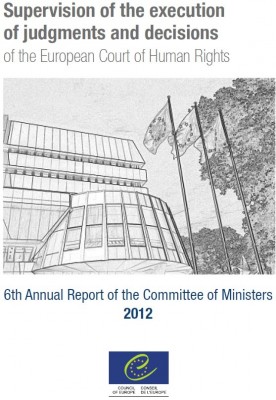
Such "pending" Turkish cases constitute the greatest Number of so Serious violations among "Main Cases .. before (CoE's) Committee of Ministers (placed) under Enhanced procedure" because of "Structural or Complex Problems.. identified by the ECHR In its Judgements ", which are "considered Important, in particular in view of their Potential to Generate Repetitive Cases" of Violations, "or" due to the "Lack of Global Solution of the Underlying Problem", according to the locacious terminology of CoE's 2013 Report.
F.ex. Turkey still has more than 85 pending cases of "ill Treatment by Police/Gendarmerie", compared to 51 for Russia, 26 for Bulgaria, 25 for Ukraine, 24 for Romania, 18 for Moldova, 7 in Poland, 3 for Georgia and Azerbaidjan, (etc.) in similar issues.
+ Such serious Risks are obviously aggravated in the case of Turkey given the fact that Ankara is still facing also ...166 pending Condemnations by the ECHR for "Excessive Length of Detention on Remand" together with "Unfair .. Criminal Proceedings", while similar issues might be find in Russia among a part of a group of 71 cases, or possibly amidst 29 cases of "Different Violations related to Detention on Remand" in Ukraine, eventually in Germany with just 13 cases (of "unjustified extension of preventive Detentions"), 1 in Bulgaria, etc.
Ankara is even Alone, among CoE's 48 Countries, to still have a Group of 100 Condemnations for "Unjustified Interference with Freedom of Expression, owing notably to Criminal Convictions" of the Victims, (mostly Journalists, Politicians, Trade Unionists, etc), that ECHR and/or COE's Ministerial Committee "identified" as "Main Cases" of "Structural or Complex Problems .. considered Important, ... in view of their Potential to Generate Repetitive cases" of such Violations, "or because of the Lack of a global Solution to the substantive Problem", (comp. Supra).
---------------------
+ The Real Dimension of the Problem should be even more Important, if one considers also the fact that all this stands Despite ECHR's recent efforts to "Expedite" the "processing of Repetitive cases", (i.e. those concerning repeated Violations of Human Rights, by Persisting Failures to comply with previous Condemnations by the ECHR), benefit mainly Turkey, much more than others :
With almost a Hundred of cases settled in 2012 through a new procedure of so-called "Friendly Settlements" by "a simple Decision" of ECHR's Secretariat (sometimes even on cases of Torture, as f.ex. in a famous affair of the Past related to a Dissident Refugee in Denmark, or even Murders, etc), Ankara was second only to Poland (98 and 111 cases respectively) in being recently allowed to "Close" the greatest number of Pending cases of Human Rights' Violations by benefiting of a controversial New "Protocol 14" more "Expeditive" process, (which had notoriously attracted in the Past various Criticisms from International Human Rights' Organizations).
In comparison, the Biggest COE's Member State : Russia, hasn't yet benefited from this overSimplified Procedure but only in ... 5 cases closed by "Friendly Settlements", while Turkey is followed, from far away, by Hungary, FYROM and Serbia (with 53, 46 and 47 "Friendly Settlements" on 2012), Ukraine (35 "Friendly Settlements"), Croatia, Italy and Romania (18 and 17 cases each, respectively), Moldova (14), the Slovak Republic and Finland (9 and 8), etc. As for Big Western EU Countries as the UK, Germany and France, or Spain, they have only used that in just ..5, ..2 each, and ..0 (zero) cases, respectively !
-------------------
These notes obviously don't even mention the well known cases of Hundreds of Thousands of Refugees/Displaced Persons from the Occupied Territories of Cyprus still controlled by Ankara's Foreign Invasion Army, still hindered to Return to their Ancestral Land, not even to Restore their Family Homes and Private Properties, illegaly usurpated since 1974 according to ECHR's case-law since 1996, 2001 and 2009, 2010, 2012, etc., nor even to the Thousands of still "Missing" Greek Cypriot People who "Disappeared" since the 1974 Turkish Military Invasion, without anyone ever being found and punished among those Responsible for their Enforced Disappearance, as ECHR's well-established case-law requires, (at the difference of what is happening until recently in other cases of "Missing" Persons dating from the 1970ies, even in Latin America (f.ex. Argentina, etc).
----------------------------------

CoE has recently decided to start exerting more Pressure in order to solve, at last, such long-standing and sometimes even growing, (as shows also the particular case of Turkey : See Facts cited Supra) Problem of Non-Execution of ECHR's Judgements, according to High-Level Decisions taken officially at the latest relevant Ministerial meeting in Brighton (UK), and this is also part of a (much Wider) Protocol No 15 to the PanEuropean Convention of Human Rights, that COE's Parliamentary Assembly has scheduled to debate in Public later this Month in Strasbourg during its April 2013 Plenary Session.
***
(NDLR : "DraftNews", as already sent earlier to "EuroFora"s Subscribers/Donors. A more accurate and full Final Version may be published asap).
***
Main Menu
Home Press Deontology/Ethics 2009 Innovation Year EU endorses EuroFora's idea Multi-Lingual FORUM Subscribers/Donors FAQs Advanced search EuroFora supports Seabird newsitems In Brief European Headquarters' MAPs CoE Journalists Protection Platform
BRIEF NEWS
- 00:00 - 02.06.2021
- 00:00 - 18.10.2020
- 00:00 - 19.06.2020
- 00:00 - 18.05.2020
- 00:00 - 20.04.2020
- 00:00 - 02.02.2020
- 00:00 - 09.12.2019
- 00:00 - 27.11.2019
- 00:00 - 16.11.2019
Popular
- Yes, we could have prevented Ferguson riots says World Democracy Forum's Young American NGO to ERFRA
- Spanish People Elect CenterRIGHT Majority with 1st Party and Total of 178 MPs (6 More than the Left)
- Pflimlin's vision
- The European Athletic "Dream Team", after Barcelona 2010 Sport Championship Results
- Source Conseil d'Europe à ERFRA: Debatre Liberté d'Opposants à Loi livrant Mariage+Enfants à Homos ?
- Head of BioEthics InterGroup, MEP Peter Liese : "Embryonic stem cell research reaching its END" !?
- Spain: Jailed Turkish Terror suspect with Explosive,Drones,Chechen accomplices stirs Merah+ Burgas ?
- UN Head Ban Ki Moon at CoE World Democracy Forum : - "Listen to the People !"
Latest News
- Test Photos (f.ex.+ Invit to EU + Korea Peace meeting)
- EUOmbudsmen Conference 2022: Digital Gaps affect People's Trust threaten EF Project on EU Future ?
- French Election : Black Out on Virus, but Obligation for Fake 'Vaccines" Challenged
- Both French Presidential Candidates point at "Humanism" in crucial times...
- France : Zemmour = Outsider may become Game Changer in Presidential + Parliamentary Elections 2022
Statistics
Visitors: 63424780Archive
Login Form
Syndicate


Other Menu

EU Rapporteur on Enlargment Strategy, maistream German MEP Elmar Brok, speaking to "EuroFora", welcomed the proposal made earlier this week by French President Nicolas Sarkozy for the EU to"start Now Talks with Turkey to create a common Economic and Security area", instead of full Accession, at a period when Ankara looks more and more unfit and/or unwilling to respect EU conditions.
- "For Europe to have strong Political will, it must stop dilutiing itself in an endless Enlargement. It must have borders...Diversities enrich, on the condition that they don't undermine European Cohesion, and don't weaken EU Unity", Sarkozy stressed.
- "Countries like Turkey share a part of common destiny with Europe, with which they have a vocation to build a Privileged Relation, to be closely associated, but not to become Member of the EU" : "Noone respects his friends by telling them lies. Noone respects his friends by making them promises that will be never kept", he added.
That's why "we'd better start, from now, negotiating with Turkey to create a common Economic and Security area", Sarkozy proposed.
Significantly, the French President was repeatedly and largely applauded by EU citizens, 3 times, when he made the Turkey point, (strategically placed between Europe's "Political Will" and its cultural heritage, historically open to mutually enriching dialogue with all the World, but never diluted).
- "We could propose such a great ambition also to Russia, which must not be percieved as an Adversary of Europe, but as a Partner. Thus, we'd create a wide area, of more than 800 Million inhabitants, sharing the same Security, the same Prosperity", he concluded.

Sarkozy's move was anounced at the eve of a Franco-German Top meeting with Chancellor Angie Merkel in Berlin on Sunday, to jointly launch the EU Elections campain, after an EU Summit at nearby Prague, to launch a new kind of relations, called "Eastern Partnership", with neighboring countries such as Urkaine, Belarus, Moldova, Georgia, Armenia, Azerbaidjan, etc, (to which Russia, reportedly, is not - and does not want to be - included).
As for Ukraine, which has already expressed her wish to join the EU in future, "Kiev will have a special place, and a very important role to play", replied earlier this week in Strasbourg, to an "EuroFora" question EU Chairman in office , Czech vice-Prime Minister Alexander Vodra.
- "This direction is more Realistic for Turkey than Accession negotiations", reacted immediately EU Parliament's Rapporteur for Enlargment Strategy, mainstream German MEP Elmar Brok, commenting Sarkozy's idea for "EuroFora"
Particularly "as far as it concerns the respect of EU Rules by both sides", he added, hinting at Turkey's now obvious inability and/or unwillingness to abide with EU Acquis, EU Commitments (fex. on Cyprus, etc), and European Democracy/Human Rights rules. (Comp. infra).
Brok added that, in his view, a similar proposal might be made also to Ukraine and other neighbouring Countries, regardless if they have, or not, a "European vocation". This would not necessarily mean that there couldn't be any accession prospects at all." for all the countries that might be included in this area, according to Brok. But it's preferable, particularly for Turkey, "because it's a more Realistic approach than full Membership".
On this point, Sarkozy's proposal, (which he'll share with German Chancellor Merkel), seems more crystal-clear.
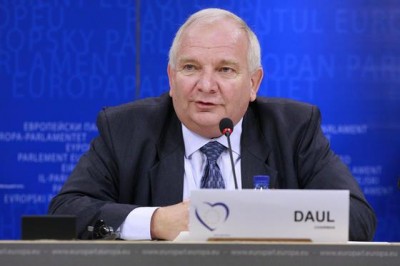
- "Turkey does not fullfil EU Criteria, and will never fullfil EU Criteria" on Human Rights, Democracy and Rule of Law. "Some have been lying to Ankara, but we must tell the Truth, and have honest and close relations with her", said meanwhile to "EuroFora" on the same issue also the President of EU Parliament's largest Group of MEPs (ChristianDemocrats/EPP), Joseph Daul.
------------------------------
"Hot" Debate at EU Parliament reveals CHANGE of mood towards "Suspension" of EU - Tukey talks.
------------------------------
Earlier this week, many MEPs, and even some of those who were previously in favor of Turkey's controversial EU bid, strongly criticized the persistance and even aggravation of serious Human Rights violations in the country, that ECHR continues to "unanimously" condemn ":
- "After winning a big victory in the latest Local Elections, the pro-Kurdish party DTP almost doubled its Elected Mayors from 52 to 98", but afterwards "more than 400 politicians were thrown to Prison and prosecuted" by the Turkish Authorities, denounced on behalf of the ChristianDemocrat/EPP Group, Belgian MEP Frieda Brepoels.
At the same time, "more than 1.500 Children are closed in Turkish Prisons", she added. "What will the EU Commission do" against these facts ?
- "Turkey appears to be at greater Distance away from Copenhagen Criteria after 4 Years of accession Negotiations, than when they started !", denounced on behalf of the Liberal Group, German MEP Alexander Lambsdorf.
"On the central issue of Press Freedom, Critical Journalists face obstacles for their accreditation, others are prosecuted, condemned, fined and/or jailed, Media blocked or closed", he denounced.
- "EU Made 2 grave Mistakes with Turkey : To start accession negotiations, and to continue them", despite everything, criticized Dutch MEP Bastian Belder, on behalf of the Ind/Dem group.